
Since 1994, Redlands Conservancy has advocated for preservation of Redlands’ historic built environment – the town’s historic resources. Many successes later, the Conservancy remains vigilant and aware of the constant need to educate and advocate. Here are some of our successes:
Saved historic 1867 Barton House from demolition

Barton House Before

Barton House After
This extraordinary building, purchased by the City of Redlands in the 1990s, had fallen into disrepair and was the victim of persistent vandalism. The city wanted to tear down this building that was so important to the history of the region. Redlands Conservancy board members spent their own money to evaluate the structure and leaned on the city to not bring in the bulldozer. Local preservationist Dr. Terry Vines purchased the building from the city and restored it for adaptive reuse as an office building and a wedding venue, and it still stands today.
Saved Historic Mitten Building from demolition

Mitten Building
Originally a citrus packing house, then a bottling plant, and finally a sign manufacturing facility, the Mitten Building stood empty for several years, except for the many transients who used the building and built fires inside to keep warm. Four Redlands Conservancy board members finally bought the building, and restored it, maintaining all of the outstanding historic features: the spectacular wooden trusses, the brick walls, the multiple levels, the industrial elevator. Today, the building is the site of many happy events – weddings, reunions, conferences, meetings, parties – and is living its second life as a star of Redlands’ historic downtown.
Saved historic Mission Gables House from demolition
Mission Gables before

Mission Gables after
Built as an apartment house in 1893, Mission Gables House was ideally situated for use by the Redlands Community Music Association (RCMA) which produces the annual Redlands Bowl Summer Music Festival, as it is located on the south side of the bowl seating. It was owned by the City of Redlands, which intended to demolish it and put in a parking lot.
Not so fast, said Redlands Conservancy and RCMA, who went to the City and convinced the Council to adaptively reuse the building for restrooms to serve the Redlands Bowl, and for rehearsal space and offices for the RCMA. After a 12-year-renovation managed by RCMA and funded partly by City of Redlands and partly by grants and private donations, Mission Gables House is another stunning gem in Redlands, and is available for rental for special events.
Saved 1903 cottage from demolition

1903 Victorian Cottage
This charming cottage was going to be demolished by its owner, the City of Redlands. The City’s demolition decision was based on the expensive need to completely eliminate hazardous lead and asbestos. Redlands Conservancy convinced the Council to sell the cottage to us for $15,000 in 2002; as a private entity, we did not need to complete eliminate, only mitigate – we could encapsulate the offending materials, have the property inspected for safety, and be on our way. We took a year to restore the cottage to be a charming, clean, “new” home ready for a first-time buyer. We found the buyer and sold the cottage for $125,000. Today, more than a decade later, the house is still well-loved and maintained, albeit in a completely different – but wonderful – color.
Saved 1898 Marten Andersen House from demolition

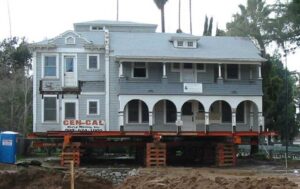
Marten Andersen house before

Marten Andersen House after
The two-story 1898 Marten Andersen House was owned by the Salvation Army, and they wanted to use the site for something else. Redlands Conservancy arranged for the Salvation Army to sell the building to the Historical Glass Museum Foundation for $1 if the Foundation would re-locate. As it happened, the Foundation owned a lot adjacent to their existing museum site – they had the spot to drop the building. Redlands Conservancy managed the re-location one-half mile to the new site, and the Foundation managed the gradual restoration. Together, the groups nominated the Marten Andersen House to the local historic resources list – this makes it eligible for possible tax benefits and parking requirement waivers. Today, the Marten Andersen House is adaptively reused as an office building.
Saved the Barton School House from demolition

Barton School House before
From 1901 to 1937, the one-room wood-frame school house served the children on the west side of Redlands. It was taken out of service when the new Mission School was built. Since then, it was a residence, dance hall, and a church, and then an abandoned derelict building. When a developer bought the property for a parking lot, the City required the developer to save the building. Redlands Conservancy helped locate a receiver – The Grove School. The charter public middle school and high school needed lots more instructional space, and the old school house needed a home, so we managed the re-location about one mile away to its new home on Orange Avenue next to The Grove School campus. After starts and stops and slow-going for a few years, a major fund-raising effort has resulted in the old school house once again being a school house. Hopefully, in 2015, the building will open for The Grove School students to use by day and the community to use by night.
Helped the City of Redlands become a Mills Act City
The Mills Act is a state law that allows owners of designated structures to realize significant property tax benefits in exchange for a contract to use those tax benefits to restore and maintain the structure. Lots of Southern California cities are in the program, but not Redlands. With help from Redlands Conservancy, the City of Redlands became a Mills Act City in 2011, with a program that would place up to five residences and two commercial buildings under contract each year. Only structures that are listed on a local register or state and national registers would be eligible. The program encourages owners of historic structures to take good care of their wonderful resources.
Saved La Rosita from Demolition

La Rosita Before
The 1960 mid-century building on Redlands Boulevard, that until recently housed La Rosita drive-thru was set to be demolished by a developer seeking to build a Starbucks on the site. Being over 50 years old and one of the last remaining businesses that represent 50s architecture style, Commissioners interjected and pushed to preserve the historic façade and signage. Redlands, being in the middle of the route from Los Angeles to Palm Springs, was traveled by many and many stopped somewhere in the middle of Redlands and there are no other examples of roadside architecture in town. SRI’s Executive Assistant, Tamara Serrao-Leiva, with the help of other supporters, has created a Facebook page to start a positive campaign in order to encourage developers to reuse the historic façade. The developer and Starbucks ultimately decided it was in the best interests of the community to restore the building and re-use it.
Saved Historic MOD Packing House


The historic Mutual Orange Distributors (MOD) Packinghouse, built in 1912 as a citrus packing house, stood vacant for many years until being purchased by Arteco Partners. Now, this landmark building’s history will be preserved as it becomes a culinary marketplace that celebrates Redlands’ agricultural heritage. The Redlands Public Market will showcase more than a dozen eateries and food artisans that will make residents become regulars and turn visitors into food tourists. The masonry and steel-framed building has brick walls and arched doorways, skylights, an old service elevator, basement and other remnants of its days in the citrus-packing industry. It’s considered a contributor to the Santa Fe Depot District, a National Register District, that includes 17 contributing properties in the downtown core.
Saved Judson & Brown Ditch
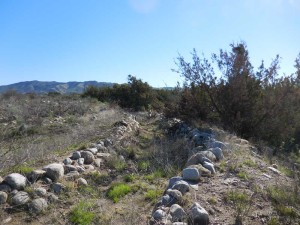
Redlands founders Edward Judson and Frank Brown built a ditch in 1881 to bring water from Morton Canyon on the north side of the Santa Ana River wash to the south side where their new community was sprouting. The 5.5 mile long, cobble-lined ditch carried 400 inches of water across property that is now owned by Redlands Conservancy, south of the Santa Ana River wash and east of Redlands Municipal Airport.
More than 130 years after it first carried water, the ditch is in remarkably good condition, and you can still follow the meandering channel exactly where Brown designed it and the Native Americans built it. Judson and Brown Ditch was listed in 2015 on the National Register of Historic Places. Historic, indeed, for Redlands’ progress into existence.
The Judson and Brown Ditch will be open to the public eventually, as appropriate protective measures are put in place and a safe trail can be built to reach the ditch.
